
Choosing a hospital or a surgeon in another European country can feel overwhelming when you are not familiar with local standards. The good news is that quality in European healthcare is not just a promise: it is documented, audited and published by official bodies. Before you book anything, you can check accreditations, certifications and quality indicators yourself, from your laptop. The key distinction to keep in mind throughout this guide is simple: accreditation evaluates the hospital, certification validates the practitioner.
Direct answer: To identify trustworthy care in Europe, verify that the hospital holds a recognised national accreditation (such as HAS certification in France), check the surgeon’s registration on an official medical council register, and compare published quality and safety indicators before committing.
What Is Medical Tourism in Europe and How Does It Work?
Medical tourism in Europe refers to patients travelling to another European country to receive planned medical care, most often surgery or specialised procedures. Within the European Union, cross-border care is framed by patient rights that allow access to healthcare in another member state under specific conditions. Outside the EU, countries like Andorra, Switzerland or the United Kingdom have their own national frameworks.
A typical journey has four stages: research and comparison, remote consultation and booking, treatment on site, and post-operative follow-up. Each stage carries its own quality checks. Research is where you compare accredited hospitals and certified surgeons. Booking is where you confirm written estimates, admission dates and travel logistics. Treatment and follow-up are where continuity of care matters most, especially once you return home.
You can approach a hospital directly or go through a medical facilitator who coordinates the stay. A facilitator such as International Elite Care can help structure the parcours, from pre-operative consultations to logistics, while you remain in charge of the medical choices themselves. Whichever route you choose, the quality criteria to verify are the same.
How to Verify Hospital Accreditation and Certifications in Europe?
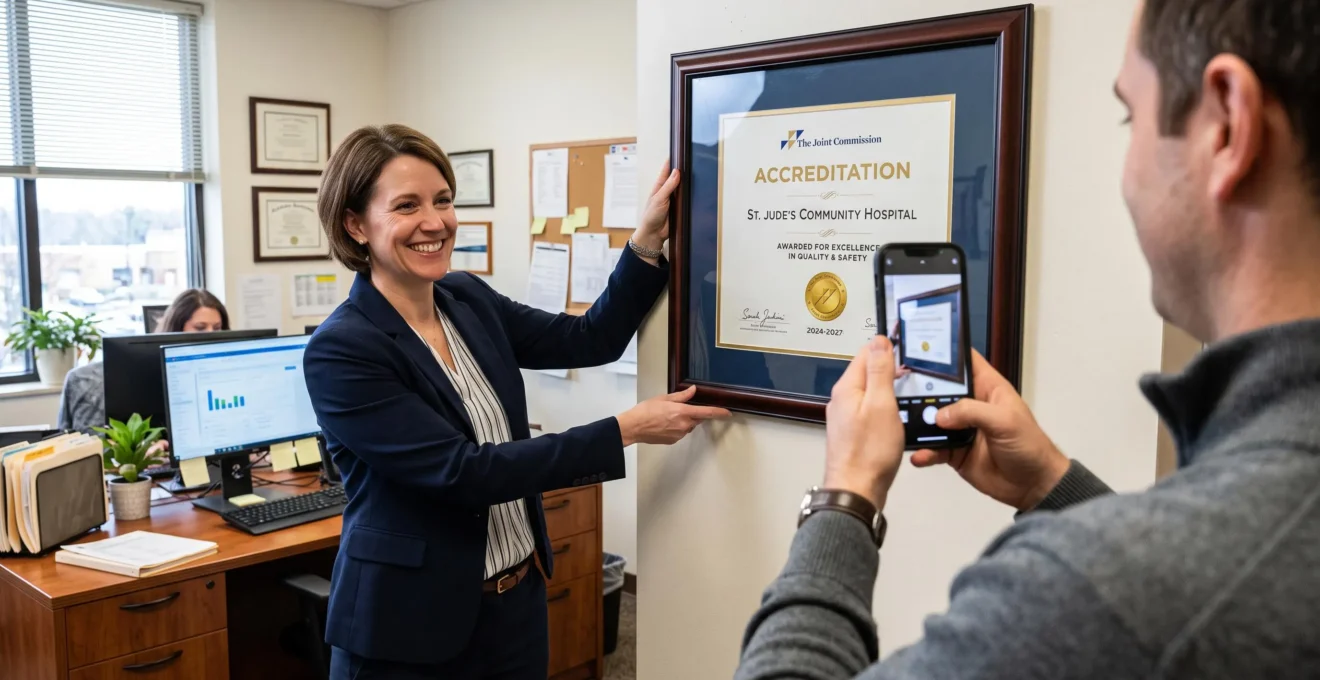
Accreditation is an external evaluation of a healthcare facility, carried out by an independent body against published standards. In Europe, accreditation systems are mostly national. In France, for example, the Haute Autorité de Santé (HAS) runs a mandatory certification programme for all public and private healthcare establishments. Other countries have their own equivalents: the CQC in the United Kingdom, the G-BA in Germany, or the IGJ in the Netherlands.
According to the official HAS certification framework, the French system is a mandatory external evaluation carried out every four years by expert-visitors, with four possible decision levels ranging from Haute qualité des soins to Qualité des soins insuffisante. Knowing the decision level of a specific hospital is a concrete, verifiable element.
Accreditation vs certification: the two words are often used interchangeably, but they are not the same. In this guide, we use accreditation for the evaluation of the whole establishment (hospital, clinic) and certification for the validation of an individual professional’s qualifications. Some countries, including France, use the word “certification” for hospitals too. What matters is to check who evaluates what, and against which standards.
Quick checks before you trust a hospital’s quality claim
- Identify the national accreditation body for the country concerned.
- Look up the hospital’s name directly on that body’s official registry.
- Check the date of the last evaluation and the decision level issued.
- Compare what the hospital claims on its website with what the official source says.
- Treat vague phrases like “internationally recognised quality” without a named body as a warning sign.
Questions worth asking a surgeon before booking:
- Which specialty title do you hold, and which body issued it?
- In which national register can I verify your licence?
- How many procedures of this exact type do you perform per year?
- What are your typical complication rates for this procedure?
- Who will manage my follow-up if a problem arises after I return home?
Red flags in a surgeon’s profile: no mention of a national medical register, specialty titles that do not match the procedure, refusal to provide a written estimate, pressure to decide quickly, promises of “guaranteed” results, or communication only through a sales representative with no direct access to the practitioner.
Which Quality Benchmarks Should Guide Your Decision?
Beyond accreditation and individual credentials, European health authorities publish quality and safety indicators that can help you compare hospitals. These typically cover patient safety (healthcare-associated infections, surgical complications), care processes (medication safety, pain management) and sometimes patient-reported outcomes.
In France, the HAS publishes aggregated data on the overall quality of care. In its press dossier on quality of care indicators from the 2025 certification cycle, the authority reported that 71.6% of healthcare establishments were classified in category A or B in MCO in 2025, up 5.3 points compared with 2024, and that 90.5% of establishments had been certified by the end of the 5th cycle. These are aggregate figures for France, not a direct ranking of individual hospitals, but they give useful context on the national baseline.
Indicators are not directly comparable from one country to another. A Sciences Po research overview on European quality measurement notes that some countries use simple indicators while others rely on composite indicators broken down into sub-indicators to allow comparison. In practice, this means you should compare hospitals within the same country first, using the same national metric, rather than mixing figures from different systems.
How to read quality data as a non-expert:
- Identify the indicator and the authority publishing it.
- Check the reference period (a single year, or a multi-year trend).
- Compare the hospital’s score with the national average or benchmark.
- Look at the trend over several years, not just a single result.
- When in doubt, ask the hospital directly how it interprets its own data.
Keep in mind: published indicators measure average performance at the establishment level. They do not predict your individual outcome, which depends on your health status, the specific procedure, and the surgical team involved.
Planning a Safe Medical Stay: Coordination and Support
Once accreditation, certification and quality indicators are verified, the practical organisation of the stay becomes the next priority. A safe medical journey is one where every step is anticipated: medical records, pre-operative consultation, travel, hospital admission, discharge and post-operative follow-up back home.
Start by preparing a complete medical file: recent imaging, blood tests, current prescriptions, allergies and relevant medical history, ideally translated into the language of the care team. Request a written estimate covering the procedure, hospital stay, implants if any, and potential additional costs. Confirm who will be your point of contact before, during and after the stay.

- Verify the hospital
Confirm its accreditation on the official national registry, with the exact date and decision level.
- Verify the surgeon
Check their registration on the national medical council register and confirm their specialty title.
- Compare quality indicators
Review the latest published safety and quality data for the hospital, within its national system.
- Get a written estimate
Request a detailed quote covering surgery, hospitalisation, implants and possible extra fees.
- Plan continuity of care
Identify who will manage your post-operative follow-up once you return home, and how complications will be handled.
Practical scenario
A patient considering orthopaedic surgery in France begins by searching the HAS registry to confirm that the hospital holds a current certification with a positive decision level. She then checks the surgeon’s name on the Ordre des médecins register and confirms his orthopaedic specialty. She compares two hospitals using publicly reported safety indicators, requests a written estimate from each, and asks both teams how post-operative follow-up will be organised once she is back in her home country. Only then does she decide which option to book. This hypothetical journey illustrates the sequence; it is not a real patient testimonial.
What is the difference between accreditation and certification in Europe?
In this guide, accreditation refers to the external evaluation of a healthcare establishment, while certification refers to the qualification of an individual professional. Terminology varies by country: France uses “certification” for hospitals too. The important point is to identify the evaluating body and what exactly it covers.
How can I verify a surgeon’s qualifications in another country?
Most European countries have a national medical council or chamber that maintains a register of licensed doctors and their specialties. Ask the surgeon which register they are listed on and verify their name and specialty title directly on that official source.
What happens if I have complications after returning home?
This is a question to settle before booking. Clarify with the hospital and surgeon who will handle post-operative follow-up, how medical records will be shared with your local doctor, and what the protocol is if a complication arises. A clearly defined follow-up plan is itself a quality signal.
Which questions should I ask before reserving a medical stay in Europe?
Ask for the hospital’s accreditation details, the surgeon’s register and specialty title, the number of procedures of your type performed each year, published complication rates when available, a written estimate, and the full follow-up plan after discharge.
If you want help structuring these checks and coordinating logistics without giving up control over the medical decisions, you can request guidance from a specialised facilitator. The goal is not to replace your own verification work, but to make it faster and more systematic.
This article provides general information on quality standards in European healthcare and does not constitute medical advice. Any decision regarding surgery or medical treatment should be discussed with qualified healthcare professionals who have access to your personal medical file.